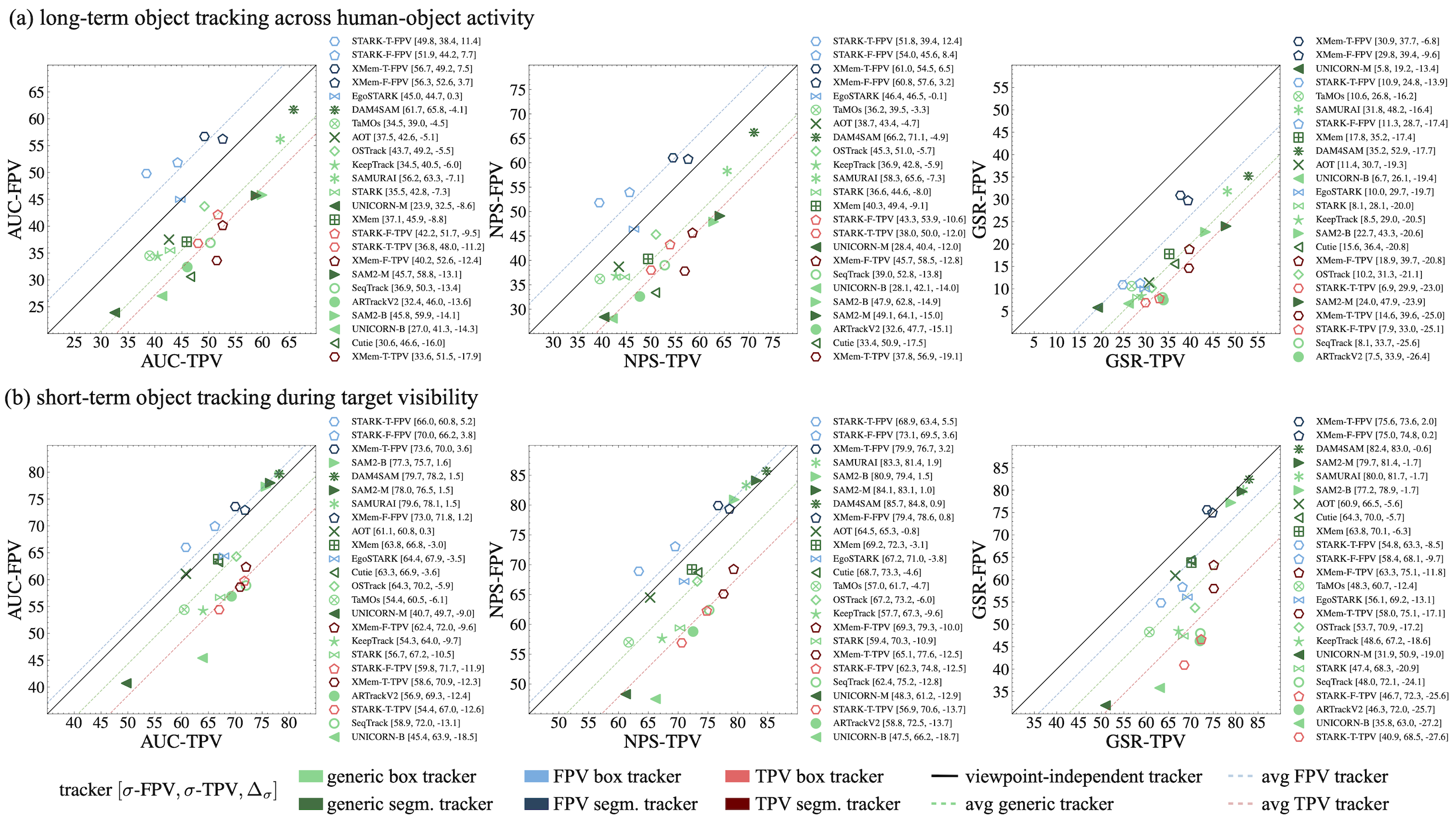
1. We isolate the real impact of first person vision (FPV) in object tracking evaluation. (a) Previous benchmarks claimed the challenges of tracking in FPV by comparing algorithm performance on third person vision (TPV) datasets having mismatched object categories and contexts. This inconsistency makes it difficult to isolate the true impact of the FPV viewpoint. (b) This paper addresses this problem by directly evaluating object tracking in synchronized FPV and TPV videos of the same human-object activity.
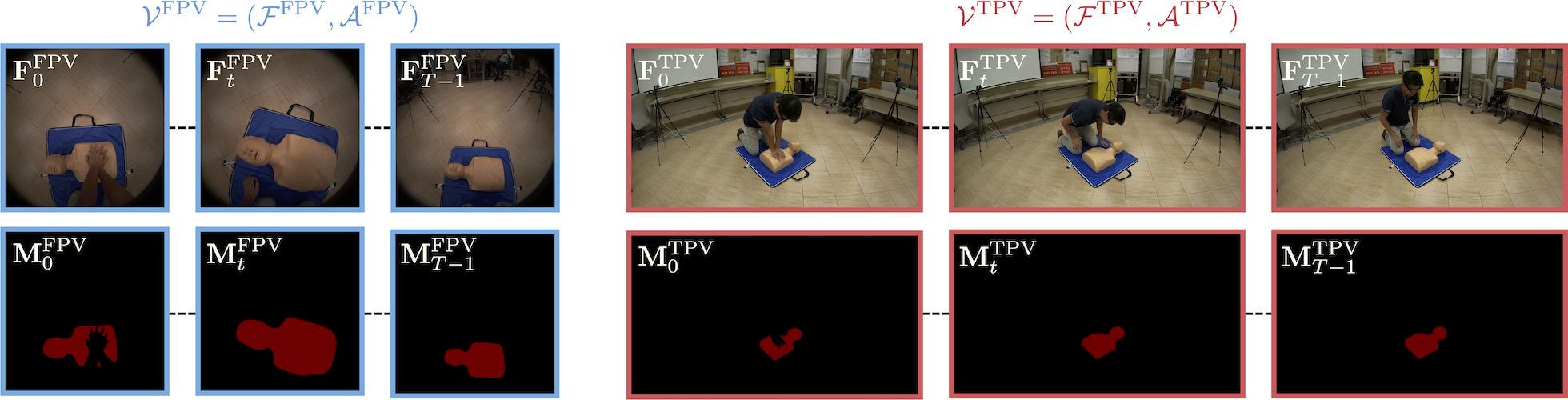
2. Examples of video sequences used in our evaluation. Our VISTA benchmark dataset is composed of pairs of annotated videos \(\mathcal{V}^{\text{FPV}}\), \(\mathcal{V}^{\text{TPV}}\) where FPV frames \( \mathcal{F}^{\text{FPV}}= \{ \mathbf{F}_t^{\text{FPV}} \}_{t=0}^{T-1} \) are synchronized to TPV frames \( \mathcal{F}^{\text{TPV}}= \{ \mathbf{F}_t^{\text{TPV}} \}_{t=0}^{T-1} \) and both are annotated with the ground-truth state of a target object. In this example, annotations are segmentation masks \( \mathcal{A}^{\text{FPV}}= \{ \mathbf{M}_t^{\text{FPV}} \}_{t=0}^{T-1}, \mathcal{A}^{\text{TPV}}= \{ \mathbf{M}_t^{\text{TPV}} \}_{t=0}^{T-1} \).